Fintech hiring has a credibility problem. Teams are hiring experienced people with impressive CVs, yet delivery issues, misalignment, and early exits persist. On paper, the talent looks strong. In practice, outcomes fall short.
This disconnect has pushed fintech leaders to question what they are really measuring during hiring. Technical skills matter, but they are no longer the deciding factor in performance or retention.
Behavioural benchmarking has emerged as a more reliable predictor of success in fintech roles, particularly under pressure. It shifts focus from where someone has worked to how they operate when things are difficult.
Why CVs Fail to Predict Fintech Performance
CVs are historical documents. They summarise experience in controlled environments, not performance under uncertainty.
In fintech, uncertainty is constant. Regulatory changes, shifting priorities, and delivery pressure are normal conditions. A CV cannot show how someone responds when deadlines clash or when risk must be communicated upwards.
Hiring decisions based heavily on CVs assume that past success automatically translates to future performance. This assumption breaks down in high-growth, regulated environments.
The result is technically capable hires who struggle with ownership, prioritisation, or stakeholder communication.
The Limits of Traditional Interviewing
Most fintech interviews reinforce the same problem.
Candidates are asked to describe past projects, explain technologies, or solve hypothetical problems. Strong candidates prepare well and perform confidently.
What these interviews often miss is behavioural consistency. How someone acts under stress is rarely explored deeply. How they challenge assumptions, escalate risk, or manage ambiguity remains untested.
This creates a false sense of certainty. Teams feel reassured, only to discover gaps months later when pressure increases.
What Behavioural Benchmarking Actually Measures
Behavioural benchmarking focuses on how people think and act, not just what they know.
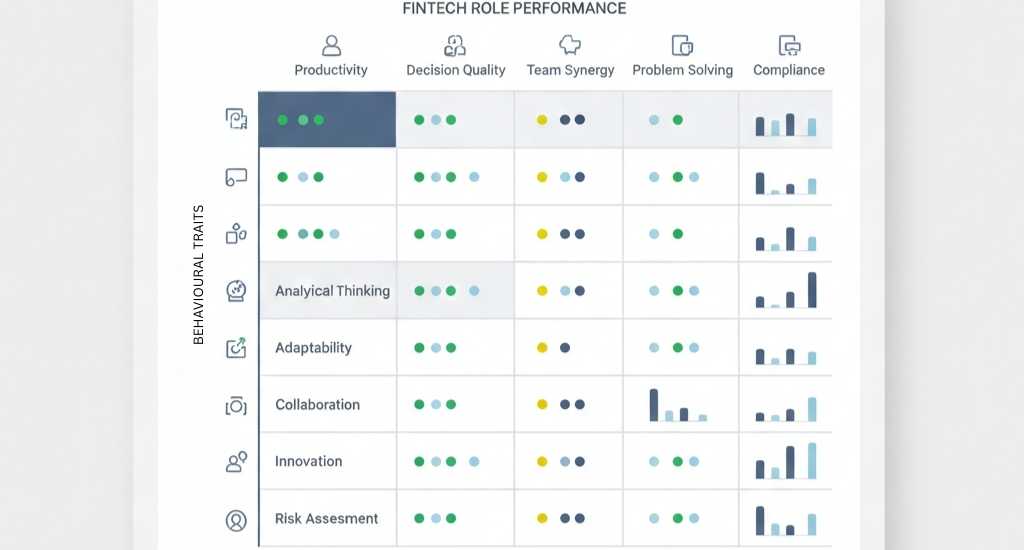
It assesses decision-making style, response to pressure, tolerance for ambiguity, and ownership mindset. These traits shape day-to-day performance far more than niche technical knowledge.
In fintech roles, behavioural benchmarks might include how engineers prioritise when compliance and delivery conflict, or how leaders respond when plans need to change quickly.
These behaviours are stable over time. Skills can be learned. Operating style rarely changes.
Why Behaviour Matters More as Fintech Teams Scale
As fintech teams grow, individual behaviour has a wider impact.
A senior engineer who avoids difficult conversations slows entire teams. A leader who over-controls blocks progress. Someone who escalates risk early protects delivery.
These behaviours determine whether teams move smoothly or constantly fight.
Behavioural benchmarking helps identify patterns before hiring decisions are made. It reduces reliance on instinct and increases consistency across interviewers.
This is particularly valuable in January and Q1, when hiring pressure can push teams towards quick decisions.
Behavioural Mismatch and Early Turnover
Many early exits in fintech trace back to behavioural mismatch.
The role demands autonomy, but the hire expects direction. The environment requires adaptability, but the hire prefers stability. Pressure increases, frustration builds, and disengagement follows.
These issues are rarely visible during CV screening. They surface only once the role is underway.
Behavioural benchmarking exposes these mismatches early, reducing costly turnover and disruption.
This is one reason specialist partners like Rec2Tech increasingly integrate behavioural assessment into senior fintech hiring, particularly for roles tied to delivery risk and long-term retention.
Moving Beyond “Culture Fit”
Behavioural benchmarking is not about culture fit in the vague sense.
It is about role fit. Different fintech roles require different behaviours. A startup engineer needs high adaptability. A platform stability role requires risk sensitivity and discipline.
Treating all behavioural traits as universally positive leads to poor matches. Benchmarking defines what good looks like for a specific role at a specific stage.
This precision improves hiring accuracy and team balance.
How Behavioural Benchmarking Improves Team Dynamics
Hiring with behavioural clarity improves more than individual performance.
Teams become more predictable. Communication improves. Conflict decreases because expectations are aligned.
Managers spend less time compensating for mismatches and more time enabling progress.
Over time, this creates a healthier environment where performance is sustainable rather than reactive.
Why Behavioural Assessment Is Often Skipped
Despite its benefits, behavioural benchmarking is often skipped.
It requires time, structure, and expertise. It feels less tangible than reviewing a CV. Under hiring pressure, teams default to familiar methods.
There is also discomfort. Behavioural assessment can challenge assumptions and expose uncomfortable truths about what a role really requires.
However, skipping this step transfers risk downstream, where the cost is far higher.
Integrating Behavioural Benchmarking Into Hiring
Behavioural benchmarking does not replace technical assessment. It complements it.
Strong hiring processes define behavioural expectations upfront, test them consistently, and align interviewers around shared criteria.
This reduces bias and improves decision quality, especially when multiple stakeholders are involved.
When done well, behavioural benchmarking accelerates onboarding and improves retention, because hires enter roles with clear expectations.
The Long-Term Impact on Fintech Hiring Outcomes
Over time, teams that prioritise behavioural benchmarking see fewer early exits, stronger delivery consistency, and improved leadership pipelines.
Hiring becomes more strategic. Roles are featured clearly. Decisions are defensible.
Most importantly, teams spend less time fixing hiring mistakes and more time building products.
What to Do Next
If your fintech hiring process still relies heavily on CVs and unstructured interviews, it may be time to reassess what you are optimising for.
Behavioural benchmarking fintech hiring is not a trend. It is a response to the realities of scaling in complex, high-pressure environments.If you want to improve hiring accuracy, reduce early turnover, and build teams that perform under real pressure, book a call with the Rec2Tech team about integrating behavioural benchmarking into your hiring strategy.