Contract vs Permanent: Picking the Right Mix for Q4 Fintech Growth

For fintech leaders, Q4 rarely feels like a winding-down period. Instead, it is often the quarter that makes or breaks annual targets. As year-end funding rounds approach and regulatory deadlines loom, the pressure to scale fast becomes acute. Yet hiring decisions made under this urgency can leave long-term consequences. Should you lean on contract talent to deliver speed, or focus on permanent hires to build stability? The reality is that the strongest strategy is rarely one or the other—it’s finding the right balance. This guide explores how fintech startups and scaleups can evaluate contract versus permanent hiring in Q4, and how a blended approach supports growth while safeguarding retention. Why Q4 Magnifies Hiring Pressure Q4 in fintech is a uniquely high-stakes quarter. Companies are often: These pressures translate into intensified demand for tech talent. Startups that fail to staff key engineering, data, or security roles risk delaying launches or missing compliance windows—both of which directly affect valuation and market credibility. A clear hiring strategy (contract, permanent, or hybrid) is essential to avoid scrambling under pressure. The Case for Contract Talent Contract professionals bring speed and flexibility, two assets in short supply during Q4. 1. Fast Deployment Specialist contractors can often be onboarded in days, not months. When product deadlines are measured in weeks, this speed can mean the difference between delivering to clients or issuing delays. 2. Plugging Skills Gaps Fintech demands niche expertise—cryptography, regulatory tech, AI/ML engineering—that may not justify a permanent headcount. Contractors provide access to rare skills exactly when needed. 3. Budget Agility Contracts can be tied directly to project milestones, aligning spend with funding flows. This reduces the long-term financial commitment at a time when cash preservation is critical. Example: One London-based payments startup hired a senior DevSecOps contractor for a 10-week sprint ahead of a regulatory audit. The role was too niche for a full-time hire but too critical to risk deferring. The Drawbacks of Over-Reliance on Contractors While contractors solve urgent challenges, relying on them exclusively carries risks. The lesson is clear: contracts are powerful accelerators, but should be deployed with intent. The Case for Permanent Hires Permanent staff remain the foundation of fintech growth. 1. Stability and Retention A core team aligned with company culture ensures continuity through funding cycles and market shifts. Investors value stable leadership and technical teams who can carry projects beyond short sprints. 2. Institutional Knowledge Permanent hires accumulate context over time, making them invaluable for long-term roadmaps and complex integrations. 3. Employer Brand Growth Building a permanent team signals stability to both candidates and investors. It also fosters internal loyalty, as employees see a pathway to grow with the company. Example: A Series B lending platform invested in permanent hires across its data science unit. The payoff came a year later when continuity in the team allowed them to pivot seamlessly to new risk models during a volatile credit cycle. Permanent Hiring Pitfalls in Q4 Contract vs Permanent: A Framework for Q4 Fintech Growth The smartest fintech leaders treat Q4 hiring like portfolio management. Contracts provide liquidity and flexibility, while permanent hires represent long-term assets. Balancing the two requires answering key questions: 1. What is the Immediate Goal? 2. Where is the Talent Gap? 3. What is the Funding Horizon? The Hybrid Model: A Strategic Middle Ground Fintechs growing sustainably often adopt a hybrid approach. This structure creates resilience. The permanent base ensures continuity, while contractors flex capacity for high-demand sprints without overburdening payroll. Analogy: Think of it as building a house. Permanent hires are the foundation and frame—essential for structure. Contractors are the specialist trades who arrive to wire, tile, or inspect before moving on. Both are needed, but their contributions differ. How Q4 Funding Shapes Hiring Decisions Investors scrutinise both speed and sustainability. Too many contractors raise questions about long-term execution capacity, while bloated permanent payrolls pre-funding can signal risky burn rates. A data-led approach to hiring—factoring cost modelling, psychometric alignment, and retention probabilities—helps founders demonstrate to investors that talent decisions are measured, not reactive. Practical Steps for Fintech Leaders in Q4 How Rec2Tech Supports the Balance At Rec2Tech, we specialise in helping fintech firms structure hiring strategies that combine agility with retention. Our contract arm delivers senior engineers in an average of 72 hours, while our permanent placements carry a 96% 12-month retention rate. By embedding psychometric assessments, cultural fit diagnostics, and post-hire support, we ensure every hire—temporary or permanent—contributes to long-term value. For Q4, we often advise clients to lock in critical permanent hires early, while using contract placements to deliver sprints, cover regulatory deadlines, or bridge gaps ahead of funding milestones. Rethinking Hiring as a Growth Lever Q4 hiring is less about filling seats and more about aligning strategy with growth outcomes. The right mix of contract and permanent talent gives fintech leaders a competitive edge, balancing speed with sustainability. Those who view hiring as a lever for valuation—not just a back-office function—are the ones who close the year strong and enter the next funding cycle with confidence. If you’re heading into Q4 and weighing contract versus permanent hires, speak to Rec2Tech today. We’ll help you build a hiring mix that delivers immediate results while setting you up for retention-driven growth.
Three Behavioural Signals Predicting 12-Month Retention

Technical skills may secure a candidate the role, but it’s their behaviour that keeps them in the seat. For fintech scale-ups, this distinction is crucial. Hiring for technical ability alone is like investing in a high-performing stock without looking at volatility — the returns look good upfront, but the instability can wipe out gains over time. The cost of mis-hires in fintech is steep. Beyond the £50k–£80k in direct and indirect costs, failed hires derail product roadmaps, increase stress for remaining team members, and weaken credibility with investors. What separates hires who thrive from those who exit within months often comes down to behaviour — and three signals stand out above the rest. At Rec2Tech, we’ve benchmarked thousands of placements. Our data shows that candidates who display learning agility, accountability, and cultural alignment are significantly more likely to remain in their seats past the 12-month mark. The good news? These signals are visible long before contracts are signed. Signal 1: Learning Agility Fintech doesn’t stand still. Frameworks shift, regulations tighten, and customer expectations evolve faster than in most industries. Engineers who succeed long term aren’t necessarily those with the most polished CVs — they are those who adapt at speed. How to spot learning agility: Why it matters: Learning-agile hires reduce onboarding friction. Instead of slowing down when new tools or regulations appear, they accelerate, often becoming internal champions for change. This adaptability not only supports retention but increases resilience across the whole engineering team. Signal 2: Accountability in Action Fintech is a high-stakes environment. A bug in production can cause compliance breaches, reputational harm, or even regulatory fines. The engineers who last beyond a year are those who don’t just “own their work” in theory — they take accountability in practice. How to spot accountability: Why it matters: Teams with accountable engineers operate with higher trust and less micromanagement. When individuals demonstrate ownership, they naturally embed themselves into the mission of the company — making them far less likely to leave when challenges arise. Signal 3: Cultural Alignment with Measured Proof Culture-fit is often treated as a buzzword, but in fintech it’s a survival factor. Scaling a team quickly while chasing funding milestones is challenging enough without the added friction of misaligned values. Cultural alignment doesn’t mean hiring clones — it means ensuring shared drivers and compatible working styles. How to spot cultural alignment: Why it matters: Cultural alignment significantly reduces attrition risk. Engineers who believe in the mission and mesh with the team dynamic are less swayed by salary increases elsewhere. They stay because the work feels meaningful, and the environment supports their best performance. The Cost of Missing These Signals Failing to assess behaviour is one of the most common mistakes in fintech hiring. Traditional interviews focus on technical challenges or CV highlights, but rarely probe into behavioural predictors. The cost of ignoring this? By contrast, engineers who display all three behavioural signals are three times more likely to remain beyond the 12-month mark. For scale-ups where stability is the difference between hitting milestones and missing them, that’s not a marginal gain — it’s a survival strategy. How Rec2Tech Puts This Into Practice At Rec2Tech, we don’t leave retention to chance. Our process blends behavioural benchmarking, psychometrics, and data-driven shortlisting to identify candidates who show these signals before the offer stage. For example, our cultural diagnostics go deeper than “Do they seem like a good fit?” We measure values, motivations, and work-style preferences to ensure candidates will integrate seamlessly into your environment. Combined with structured interview frameworks and post-hire check-ins, this approach is why 96% of our placements remain in seat after a year. We’re not just filling roles. We’re building fintech teams that stick. Retention Is Predictable Skills may win the interview, but behaviour wins the long game. By paying attention to learning agility, accountability, and cultural alignment, fintech leaders can dramatically reduce costly turnover. Retention isn’t luck. It’s science. With the right tools, the tell-tale cues are visible before a candidate signs on the dotted line. Want to predict retention before it becomes a problem? Let’s talk.
Fintech Salary Benchmarks 2025: Mid-Year Engineering Update

The first half of 2025 has been anything but predictable for fintech hiring. Engineering salaries, once relatively steady, have jolted upwards and sideways in ways that make last year’s forecasts look outdated. For scale-up founders and talent leaders, this isn’t just another market report — it’s a warning light. Salary expectations are now moving as fast as venture rounds used to. Miss the shifts, and you risk losing engineers to competitors who have already adapted their offers. Let’s look at what’s driving these changes and where fintech engineering pay stands at the mid-year mark. The Big Picture: Salary Bands in Motion If 2024 was defined by budget caution and slower hiring, 2025 has flipped the script. The rebound in venture funding during Q1 triggered a wave of team expansions, particularly in payments, embedded finance, and AI-powered risk tools. With more capital came fresh demand for engineers — and rising salaries to match. Here’s how the average benchmarks look today across the UK fintech market: Contract day rates tell a similar story: senior contractors are now commanding £650–£750/day, with some niche AI/ML engineers touching £900/day when IR35 status is outside. Why Salaries Are Rising Faster Than Expected Three forces are shaping the mid-year surge: Every fintech, whether in lending, compliance, or wealth tech, is scrambling for AI expertise. The result? Salaries for data and machine learning engineers are rising like tide levels after a storm surge. New FCA (Financial Conduct Authority) requirements and tightening European data rules mean that cybersecurity and DevSecOps specialists have become indispensable. Companies aren’t hesitating to pay extra for talent that shields them from fines and reputational damage. After two cautious years, seed and Series A rounds are flowing again. When early-stage firms raise, they need engineers yesterday. That urgency is inflating salary offers, particularly for full-stack and product-facing developers. Regional Hotspots: London, Dublin, and Beyond London remains the centre of fintech pay gravity. Senior engineers in Canary Wharf and Shoreditch are now fielding offers 10–15% above the UK average. Dublin is closing the gap fast, driven by US firms planting European engineering hubs there. Elsewhere, the gap between regional UK salaries and London has narrowed. A mid-level engineer in Manchester, once £10k behind London, now sees only a £4–5k differential. Remote-first hiring is smoothing out regional pay bands, though London perks (equity, hybrid flexibility) still hold sway. The GCC and European Market Pulse Rec2Tech’s clients in the Gulf Cooperation Council (GCC) and mainland Europe are seeing similar dynamics: For scale-ups with cross-border hiring ambitions, benchmarking salaries locally is now mission-critical. What looks like a strong London offer may fall flat against Dubai’s tax-free allure or Berlin’s equity-heavy packages. Equity, Bonuses, and Non-Cash Perks It’s not all about base pay. Candidates are scrutinising equity and retention bonuses more carefully in 2025 than in any previous cycle. Fintechs that ignore these levers risk being outbid, even if their base salary is competitive. Gender Pay Gaps and Inclusion Trends The mid-year data also reveals a less encouraging reality: the gender pay gap in fintech engineering remains at 14% in the UK, slightly improved from last year’s 16%. Progress is happening, but slowly. Companies that invest in structured benchmarking and transparent salary bands are narrowing gaps faster. Those that leave pay decisions to “case-by-case negotiation” continue to lag behind. What Hiring Managers Need to Do Now Salaries are shifting quickly, and waiting for year-end reports risks leaving your offers out of touch. Here’s where fintech leaders should focus in the next six months: Why Rec2Tech Tracks Salary Shifts in Real Time At Rec2Tech, we’ve seen retention dip whenever founders underestimate how fast the market is moving. Our data-driven hiring models don’t just shortlist the right engineers — they also benchmark offers against live market conditions, ensuring placements stick beyond the 12-month mark. With 96% of Rec2Tech placements still in seat after a year, it’s clear that matching compensation to market reality isn’t optional. It’s the difference between building a stable team and fighting endless turnover. A Storm Worth Preparing For Fintech salaries in 2025 are shifting like summer weather over Canary Wharf: hot, humid, and suddenly turbulent. Founders who treat pay as a once-a-year exercise will be caught in the storm. Those who adjust mid-year, bake flexibility into offers, and leverage smarter benchmarking will ride out the volatility with stronger, more loyal teams. At Rec2Tech, our process blends behavioural benchmarking, psychometrics, and data-driven shortlisting to deliver hires that stay. By aligning compensation with market reality and cultural fit, we help fintech scale-ups secure engineers who remain in seat long after day one.If you’d like tailored benchmarks for your engineering team — across London, Europe, or the GCC — Rec2Tech can help. Schedule a strategy call today:
Inside Rec2Tech-IQ: Data-Led Hiring That Delivers 96% Retention
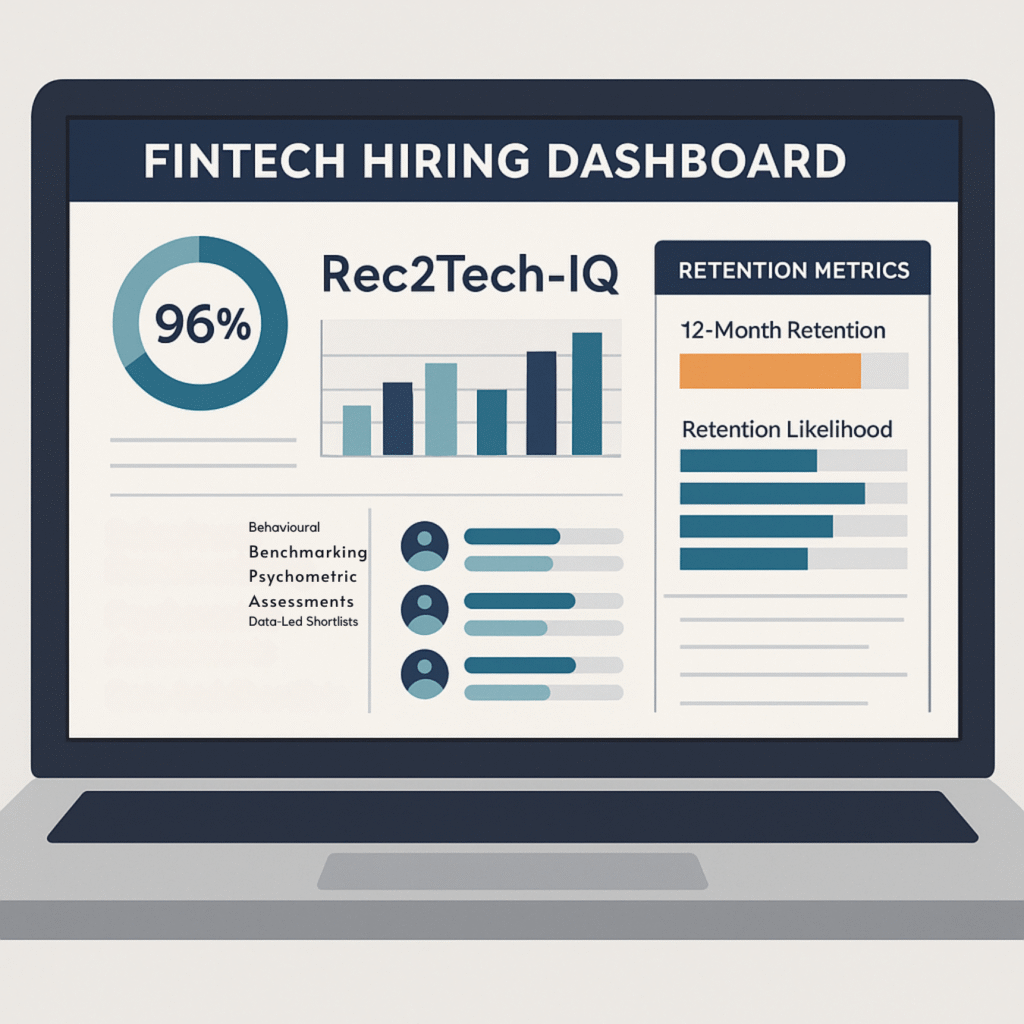
In fast-growth fintech, the pressure to hire quickly can be relentless. Funding rounds accelerate product roadmaps, clients demand new features, and compliance deadlines loom. Amid all that urgency, hiring mistakes are common and costly. Studies show that a single mis-hire at a senior tech level can drain six figures in lost productivity, recruitment fees, and missed opportunities. For startups and scaleups operating with lean teams, the wrong hire doesn’t just slow progress. It can derail entire projects, delay launches, and even shake investor confidence. That’s why retention, not just speed, must be the ultimate measure of hiring success. Rec2Tech-IQ was built on that principle. And it’s the reason 96% of placements are still in their roles 12 months on. What Is Rec2Tech-IQ? Rec2Tech-IQ is the data-driven hiring methodology developed by Rec2Tech for fintech startups and scaleups. It combines three elements that traditional recruitment often treats as separate: The approach doesn’t just identify who can do the job; it identifies who will stay in the job and thrive. Why Traditional Hiring Falls Short in Fintech Many fintech leaders admit that their hiring process is still largely gut-driven. CVs get skimmed, interviews are rushed, and cultural fit is judged on instinct. That can work for low-risk roles, but in a competitive, regulated sector, the stakes are higher. Three common pitfalls cause most hiring failures in the sector: Rec2Tech-IQ addresses these gaps by grounding every stage in data, not assumptions. Step-by-Step: How Rec2Tech-IQ Works 1. Role Assessment & Success Blueprint Before a search begins, Rec2Tech works with hiring managers to define the role beyond the job description. This includes: This blueprint becomes the benchmark for candidate evaluation. 2. Behavioural Benchmarking Using data from psychometric tools and team performance analysis, Rec2Tech builds a behavioural profile for the role. This isn’t guesswork; it’s based on traits and motivators that correlate with retention and high performance in similar fintech environments. 3. Multi-Layer Candidate Assessment Every candidate goes through a multi-stage process: 4. Data-Led Shortlist Delivery Instead of sending over a stack of CVs, Rec2Tech delivers a curated shortlist. Each profile includes a retention likelihood score, behavioural match data, and key motivators so hiring managers can make informed decisions quickly. 5. Post-Hire Engagement Retention doesn’t stop at offer acceptance. Rec2Tech runs structured post-hire check-ins at key intervals: 1 month, 3 months, 6 months, and 12 months. These touchpoints help address potential friction early and keep talent engaged. The Results: 96% Retention After 12 Months The proof of the process is in the numbers. Across placements made since 2022, 96% remain in role a year later. For fintech companies, this translates into: Why Data-Led Hiring Works Better in Fintech Fintech isn’t like other sectors. Its blend of regulatory pressure, rapid innovation, and high-stakes funding means that team misalignment can be fatal. Data-led hiring offers three distinct advantages: The Future of Hiring at Fintech Scaleups The competition for senior tech talent will only intensify. Emerging areas like blockchain, AI-driven risk modelling, and embedded finance are creating roles that didn’t exist five years ago. The ability to hire — and keep — rare talent will be a defining factor in which scaleups succeed. Rec2Tech is already expanding Rec2Tech-IQ with deeper analytics, including: What Founders Can Do Now If you’re leading a fintech startup or scaleup, here are three practical steps to strengthen retention before your next hire: Retention Is a Strategic Metric Too many hiring processes treat “offer accepted” as the finish line. In reality, the true measure of success is where that hire is in 12 months. For fintech leaders under pressure to scale fast without losing quality, data-led hiring is no longer optional; it’s the competitive edge. With Rec2Tech-IQ, Rec2Tech isn’t just filling seats. It’s building high-performing, culturally aligned tech teams that stick. The 96% retention rate isn’t a coincidence; it’s the product of a method designed for the unique challenges of fintech scaling. If you’re ready to reduce turnover, speed up hiring, and strengthen your team’s long-term performance, Rec2Tech can help. Book a call with us today.
How to Predict Which Candidates Will Actually Stay

Recruiting feels like planting trees. Some saplings shoot up fast then topple in the first winter, while others root deeply and stand for generations. The skill is knowing which seedling you are looking at before you re-pot it into your company garden. Below are eight practical techniques—drawn from behavioural science, data analytics, and field experience—that help predict which candidates will actually stay. Count the Cost of Early Exits A clear view of turnover’s price tag keeps prediction work sharp rather than academic. Calculate the full expense of churn: hiring fees, onboarding hours, productivity dips, and team morale loss. Double-check the numbers against average tenure in your sector. When leaders see that a mid-level engineer leaving after eight months can drain six figures, they become allies in refining predictive hiring. Look Beyond the CV’s Shiny Surface Traditional résumé screening tells you what a person has done, not how long they will do it for you. Years in role are stronger than brand-name employers. Plot a timeline of each candidate’s previous tenures. Two short stints may be a chance; a pattern of departures just after probation is a red flag. Add a column for geographical moves; serial relocators often restart elsewhere before roots form. Harness Survival Analytics Retention is a time-to-event question, so borrow tools from actuaries. Feed historic hiring data into a simple Kaplan–Meier curve to visualise when exits spike. Then train a proportional-hazards model on variables you can observe at application stage: prior tenure, commute distance, salary change, and required tech stack. Even a basic model will highlight which factors raise the odds of staying 24 months. Deploy Behaviour-Based Interviews What people did under pressure yesterday predicts what they will do tomorrow. Swap hypothetical questions for concrete stories: “Tell me about a time you nearly quit. What made you stay?” Probe for self-awareness and coping habits. Candidates who describe seeking feedback, reframing challenges, or designing new workflows show the stickiness you need. Score answers against a rubric so each interviewee faces the same yardstick. Test for Values Alignment, Not Cultural Cloning A cohesive culture is built on shared values, not identical personalities. Run a short values inventory — think Moral Foundations or Schwartz Portrait — early in the process. Map results against the organisation’s published principles. You are watching for complementary overlap, not perfect match. A candidate who prizes experimentation in a company that rewards measured risk fits better than one driven solely by hierarchy. Check Reference Signals, Not References Traditional referee calls produce polite platitudes. Ask previous managers two future-facing questions: Simulate Real Work Early A realistic job preview reduces mismatched expectations, the top reason for early resignations. Replace whiteboard puzzles with a half-day paid sprint on a live, low-risk problem. Pair the candidate with a future teammate so social dynamics emerge. NASA famously ran lunar-module simulations to test not just competence but crew cohesion long before launch; do the same on earthbound projects. Candidates self-select out when the preview disillusions them, saving everyone months of disruption. Maintain Momentum From Offer to Day One Preboarding is the bridge between acceptance and allegiance. Send equipment and log-ins early. Schedule a casual virtual coffee with the founder. Share a “first-30-day” roadmap so expectations are tangible. Inertia is powerful: once a candidate starts picturing their desk, teammates, and first win, rival offers look like extra effort. Putting It All Together: The Stay Forecast Toolkit Combine the steps above into a simple weekly rhythm. Step Tool Owner Time Needed Wednesday Tenure timeline in spreadsheet Talent analyst 10 min per CV Thursday Survival curve refresh Data team 30 min Friday Behavioural interview & values quiz Hiring panel 1 hr per candidate Monday Reference signals call Recruiter 15 min Tuesday Paid work simulation Team lead 4 hrs Operate the cycle for one quarter, then compare 90-day retention with last year’s cohort. Most companies spot at least a 20 percent improvement without increasing time-to-hire. A Note on Unusual Indicators Sometimes, the smallest clues forecast the longest tenure. A 2019 UK contact-centre study found that applicants who adjusted their chair height before starting a role-play stayed six months longer on average than those who left it as is. The researchers argued that proactive micro-behaviour signals ownership mindset – the same trait that keeps staff engaged when workloads surge. The Long-Game Advantage Accurate stay prediction compounds quietly, like interest. Lower churn frees budget for training, deepens institutional knowledge, and preserves customer relationships. It also boosts employer brand. Word spreads fast in specialist circles that your firm invests in fit rather than seat-filling. Over time, the hiring funnel shifts from outbound persuasion to inbound demand. Heading for Home: Grow Forests, Not Seedbeds Retention is less a guessing game and more a disciplined reading of conditions. Study tenure history, measure the soil with data analytics, test roots with behavioural probes, and water early through preboarding. Do this consistently and you will grow teams that stand firm through economic gusts, just as Kew Gardens’ 250-year-old oaks weather every London storm. Rec2Tech operates on this very philosophy—its 96 percent first-year retention proves what’s possible when prediction tools meet methodical execution.Ready to forecast your next hire’s staying power? Learn more about our process and book a consult with us.
The 96% Hiring Blueprint: How to Build a Tech Team That Sticks

Speed powers fintech success, yet rapid growth without loyal engineers drains capital fast. Founders often describe the frustration of training a developer for months only to watch them leave for a bigger offer. In 2024, Rec2Tech achieved a 96 % twelve‑month retention rate across senior placements. The blueprint below shows how, step by step, so you can copy the results. This blueprint condenses a decade of fintech recruitment lessons into a clear, repeatable process any founder can follow. This blueprint is practical: no jargon‑heavy theory, just steps tested across start‑ups handling payments, wealth tech, and open banking APIs. By the end you will have a repeatable process your team can run without outside help. Expect checklists you can paste into your ATS and interview questions ready for your next hiring call. The Hidden Cost of Mis‑Hires Hiring the wrong engineer rarely shows up as a single line item, yet its impact is felt across every sprint board. A study by the Australian Human Resources Institute estimates the total bill for a six‑month mis‑hire at 2.5 times salary. In seed or Series A firms, that figure is often cash earmarked for runway. Why Traditional Hiring Lets Founders Down Traditional pipelines were built when product cycles were measured in quarters, not weekly deployments. Paper skills tell half the story A degree from a leading university signals academic success, yet says little about pair‑programming habits, Git hygiene, or appetite for security reviews. In modern fintech, those traits drive daily value. First‑impression bias Quick judgements tend to favour candidates who mirror the interviewer’s background. The result is a narrow talent pool and groupthink, both enemies of product diversity. Mis‑matched incentives External recruiters earn when a placement starts, regardless of future retention. Internal hiring managers juggle backlog items and aim to close open roles fast. Both forces shorten due diligence and raise churn odds. The Retention‑First Hiring Framework A hiring process focused on retention treats each stage as evidence gathering. Move a candidate forward only when proof supports a long stay. 1. Clarify the Role Progress starts with a sharp role outline. The exercise often cuts ‘nice‑to‑have’ requirements, opening the door for non‑traditional candidates who can still achieve core outcomes. 2. Multi‑Layer Assessment This is the engine room of the blueprint. Layer Aim Example Method Skills Check Confirm technical baseline Pair‑programming on a small live repo Behaviour Review Understand work style under pressure Structured questions tied to past actions Values Match Test culture fit and contribution Scenario session with future colleagues Scores stay separate; a red flag in any column stops the process until clarified. 3. Guard‑Rails After Offer Fintech founders know that even a thorough process carries some doubt. A one‑year replacement promise shifts that risk from the founder to the provider. Pair this with onboarding guard‑rails: Hires feel supported; teams gain a clear picture of progress. CVs Count for Just 10 % Why give the CV a modest slice of influence? Placing too much weight here filters out capable engineers who built skills in bootcamps or open‑source projects rather than large brands. A practical hack: blur candidate names and universities on the first review pass. Many founders are surprised by how often they still shortlist the same people. Removing labels forces attention on code samples, open‑source commits, and problem‑solving explanations. Screening for Behaviour, not Skill Alone Matching values begins with defining them. Supplement interviews with objective tools such as Predictive Index to ground decisions in consistent data. Common Questions from Fintech Founders How long does the whole process take?With disciplined scheduling the three assessment layers fit inside three weeks, including reference checks. Do multi‑layer assessments put candidates off?Clear communication keeps them engaged. Most senior engineers appreciate a chance to show real ability instead of ticking keyword boxes. What if a great coder misses the behaviour mark?Invest in coaching only after clear evidence of a growth mindset. Otherwise keep the door open for a future role but pass for now. Can this work for remote teams?Yes. Pair‑programming, scenario role‑play, and behaviour interviews run well on video when guidelines are set in advance. Does this apply to non‑engineering roles?Yes. Swap the skills check for a task relevant to product, design, or risk, and keep the behaviour and values steps unchanged. Retention numbers follow a similar path. Mini Case Study: Scaling a Payments API A European payments start‑up needed ten platform engineers inside six months. Using this blueprint they filled all roles in five months and kept nine engineers for the next 18 months. The only departure moved abroad for family reasons. Key numbers: Bringing It All Together When every gate looks at retention first, your hiring pipeline becomes self‑correcting. If a candidate scores low on behaviour fit you pause rather than hoping training will fix it. That discipline protects the runway and removes the cycle of ‘hire‑depart‑rehire’. Firms that switch to this blueprint report: Next Steps: Put the 96 % Blueprint into Action Your next engineer should still be shaping features when you plan your Series B. By centering hiring around retention (clear roles, layered checks, and early support), you swap guesswork for evidence. Ready to begin? Book a 20‑minute call with Rec2Tech and build a team you can count on next year.