Hiring someone great in fintech is only half the victory. Keeping them past year one is the real indicator of team strength. Early churn disrupts product velocity, drains leadership time, inflates costs, and shakes confidence inside teams that already operate under pressure.
A strong onboarding experience prevents this spiral and gives new hires a foundation that feels stable enough to grow from.
FinTech onboarding is not a ceremonial welcome. It is the first performance environment a hire enters. If the environment feels chaotic, incomplete, or ambiguous, they assume the company operates this way permanently.
If it feels structured, supportive, and predictable, they commit faster. The first year becomes a launchpad rather than a test of survival. Onboarding gives new fintech hires their instruments. Without them, everything feels guesswork.
Good Read: Retained Search vs Contingent Recruitment: Which Works Best for FinTech
Why Retention Hinges on the First Year
Year-one churn is expensive in every industry. In fintech, the cost compounds because the skills involved sit at the centre of product delivery. When a backend engineer leaves early, it delays a sprint and often increases risk in compliance-heavy features. When a product leader exits, the roadmap fractures.
Typical impacts include:
- Delivery setbacks that affect revenue targets.
- Increased workload on teams already stretched thin.
- Loss of contextual knowledge that took months to build.
- A repeat hiring loop that costs 1.5 to 3 times the salary.
None of these are simple fixes. This is why onboarding is not an HR formality. It is risk prevention.
What New FinTech Hires Actually Need
Plenty of onboarding checklists look complete on paper. Very few match what a senior engineer or architect needs to perform well in a regulated, fast-moving environment. Here is what genuinely supports them in the first 90 days:
1. Clarity
Not motivational clarity, but practical clarity such as:
- where the product is heading
- how the team structures decisions
- which architectural choices are fixed
- which priorities matter this quarter
When hires can see the grand pattern, they settle quickly.
2. Context
Fintech is full of nuance. Even simple features can be shaped by licensing rules, security requirements, or investor pressures. New hires must learn the technical and non-technical context behind decisions. If not, they build confidently in the wrong direction.
3. Access
Tools, documentation, repos, people. Without friction. Without delay.
Waiting three days for a permission level sounds minor but sets the tone for everything that follows.
4. Early wins
The psychological effect is huge. An early win replaces doubt with momentum.
Download Our Free Guide: Bad Hire. Big Cost – How to Avoid Hiring Mistakes
Why Onboarding Fails More Often in FinTech
Three patterns show up repeatedly:
1. “They’re senior, they’ll figure it out.”
Seniority is not a substitute for structured onboarding. High performers want clarity more than anyone because clarity accelerates contribution.
2. No consistent touchpoints
A single induction cannot guide someone through their first quarter. Without follow-ups, misalignment grows quietly until it becomes resignation.
3. Tribal knowledge everywhere
If the only people who understand a system are the ones who built it, new hires start behind and stay behind. Documentation gaps are retention gaps.
When these patterns stack, the hire begins to doubt their long-term future even if the work itself is exciting.
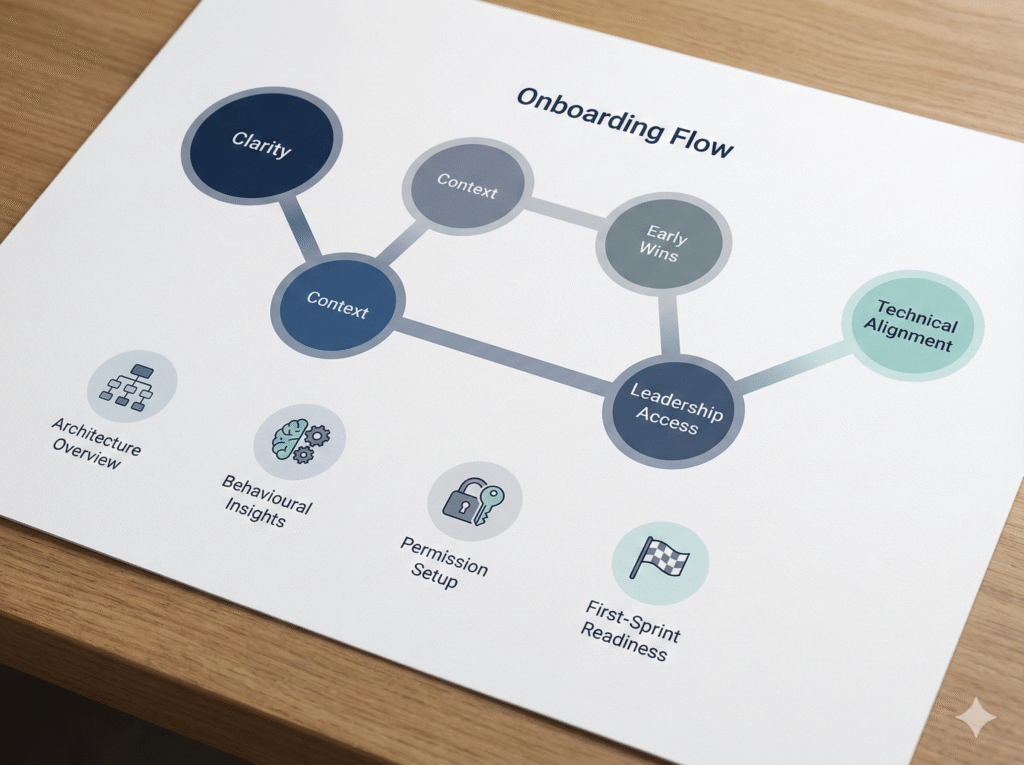
Shape an Onboarding Experience That Acts Like a Retention Engine
There is no single formula, but high-performing fintech teams share a few habits that consistently lead to better retention outcomes.
Start Before Day One
Prepare role expectations, behavioural insights, and success markers in advance. This removes ambiguity and helps managers guide early performance without guesswork.
Use a 30–60–90 plan that feels like a roadmap, not a checklist
Each stage has a purpose:
- 30 days: orientation, understanding architecture, small wins
- 60 days: deeper contribution, cross-team collaboration
- 90 days: independence, ownership, early leadership signals
The pacing matters more than the paperwork.
Blend technical onboarding with cultural grounding
A highly skilled engineer may still leave if they cannot understand how decisions move across the organisation. The cultural layer is as significant as the technical one.
Make leaders visible
A short welcome call with the CTO or VP Engineering sets a tone that retention matters and the hire is expected to succeed, not merely survive.
Normalise questions
When new hires feel safe asking questions, they integrate twice as fast. Silence is rarely a sign of comfort. It is usually the first stage of withdrawal.
Support and Coaching: Where Retention Quietly Builds
Retention does not live in the welcome pack. It lives in the weeks after.
The hires who thrive long-term usually experience the following:
- Regular feedback that is specific, not generic. General praise means little. Specific feedback builds direction.
- A peer anchor. Someone who knows the landscape and can translate decisions clearly.
- A sense of progress. Even small milestones reduce the risk of early disengagement.
- Predictability. Not rigid structure, but enough consistency for the hire to build confidence.
A common scenario Rec2Tech sees: a hire looks strong on paper but becomes quiet by week six. No conflict. No obvious performance problem. Just subtle disengagement.
In 80 percent of these cases, the root issue is one of three things: unclear expectations, lack of early feedback, or no trusted person to ask simple questions.
Small problems, if ignored, become exit decisions.
How Rec2Tech Strengthens Retention Through Onboarding
Rec2Tech’s approach places retention at the centre of every hire. This is why clients experience stronger year-one stability and fewer repeat searches.
Here is how the retention layer is built:
1. Alignment before day one
We confirm mutual expectations between you and the hire so early missteps do not snowball into dissatisfaction.
2. Behavioural and technical blueprints
These insights help managers understand how the hire communicates, learns, problem-solves, and responds under pressure.
3. Support across the first 90 days
We provide integration touchpoints that surface concerns early while helping managers interpret small behavioural cues that indicate a hire needs support.
4. Twelve months of post-hire retention care
A long-term structure ensures the hire continues to feel anchored, guided, and valued as responsibilities grow.
This is where clients see the biggest shift. Retention stops being reactive. It becomes a measurable, ongoing discipline.
The Companies That Keep Talent Are the Ones That Start Strong
Fintech teams succeed when onboarding feels like a bridge rather than an obstacle. The strongest foundations come from clarity, context, consistent support, and leadership presence.
A hire who understands the environment quickly and feels supported throughout their first year is far more likely to stay through future product cycles, funding rounds, and scale-up challenges. Stability follows.
High-performing teams know this. They do not treat onboarding as an event. They treat it as momentum creation.
Strengthen year-one retention with onboarding that gives fintech hires clarity, confidence, and long-term direction. Rec2Tech supports every stage from hire to integration. Book a call today.