FinTech scale-ups cannot afford drawn-out hiring cycles or shallow talent pools. A single mis-hire delays product delivery, slows revenue targets, and adds unexpected salary burn. Choosing between retained search and contingent recruitment shapes how quickly your company secures the right engineers, product leaders, and technical specialists.
Both models have a place, yet their impact differs sharply at scale-up level. If your roadmap depends on stable senior hires who stay through funding milestones, understanding the strengths and limits of each approach matters more than ever.
What Is Retained Search in FinTech?
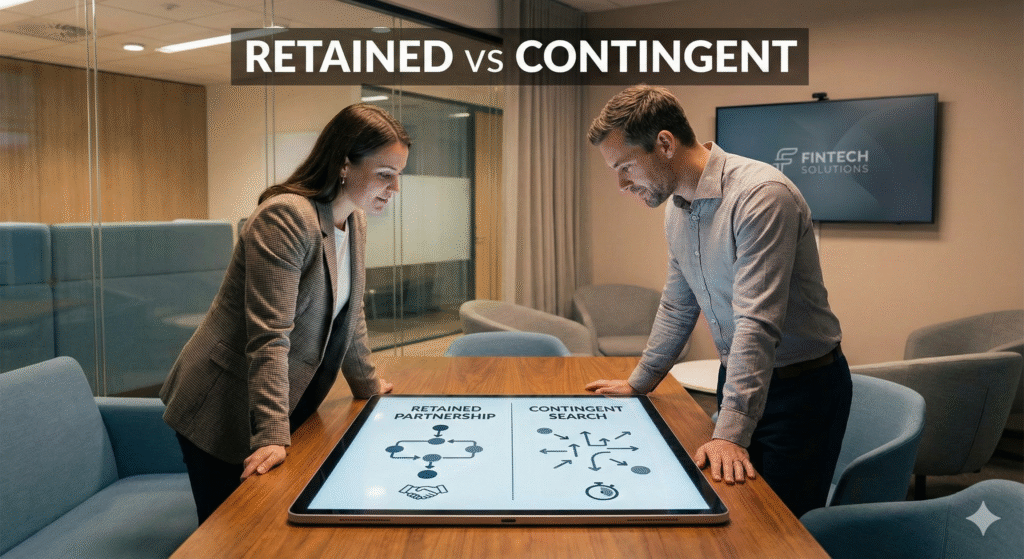
Retained search is a structured, partnership-led hiring model where your recruitment partner works exclusively on your brief. The project begins with alignment sessions, behavioural benchmarks, role definition, and market intelligence. This approach gives you methodical outreach, deeper evaluation, and a shortlist built on fit rather than speed.
Retained search suits fintechs with regulated environments, complex tech stacks, or roles that require trust and confidentiality. You receive priority access to networks and passive candidates who rarely respond to open adverts. Think of retained search like commissioning a specialist architect instead of browsing generic floor plans; you gain a design shaped precisely for your growth stage.
What Is Contingent Recruitment?
Contingent recruitment works on a “no placement, no fee” model. Multiple agencies may compete for the same role, and the initial screening aims to deliver candidates quickly. It is often used for mid-level roles or situations where speed is the main priority.
This model offers broad reach, yet it lacks the depth many fintech roles require. Because agencies compete, they focus on volume rather than full evaluation. That can work for high-turnover positions, but it becomes risky for senior or specialist technical posts.
Contingent recruitment is similar to browsing a busy marketplace; you see plenty of options, but the quality varies and the selection may not align with your long-term goals.
Key Differences Between Retained and Contingent Recruitment
1. Speed vs Precision
Retained search moves with deliberate focus. Your partner handles technical benchmarking, behavioural assessments, and structured shortlisting. This eliminates false starts and repeated rounds of screening.
Contingent recruitment feels faster at the surface because multiple CVs arrive quickly. However, the speed hides inefficiencies. You often review candidates who lack cultural fit or depth in specific fintech frameworks such as cloud-native security, transaction monitoring, or scalable architecture.
2. Access to Passive Talent
Retained partners have access to talent you cannot reach through job boards or general searches. Most senior engineers and fintech leaders are passive candidates who respond to discreet, tailored outreach.
Contingent recruiters rely more on active applicants. This narrows your pool, especially when competing with global fintech hubs across the UK, EU, and GCC.
3. Candidate Quality and Assessment
Retained search includes structured assessments, psychometrics, and cultural-fit evaluation. Every candidate is benchmarked against your growth strategy, stack maturity, and funding trajectory.
Contingent recruitment rarely includes behavioural profiling or long-term retention checks. The focus is on fast submission rather than deep analysis.
4. Commitment and Accountability
Retained search creates mutual accountability. Your recruiter commits resources and time, and you commit to a partnership.
Contingent recruitment spreads responsibility across multiple agencies. No one owns the process end-to-end, and coordination becomes fragmented.
5. Cost Efficiency Over Time
Retained search may feel like a larger upfront investment. However, it lowers long-term hiring costs through higher retention and fewer mis-hires.
Contingent recruitment appears cheaper, yet mis-hires, early attrition, and repeated searches lead to higher hidden costs.
Download Our Free Guide: Bad Hire. Big Cost – How to Avoid Hiring Mistakes
Which Model Works Best for FinTech Scale-ups?
FinTech scale-ups face unique pressures. You operate in high-stakes, high-compliance environments. Your product depends on engineering stability, secure code, and technical leadership that can adapt to rapid growth.
Retained search aligns with these demands. It gives you access to deeper networks, structured evaluation, and candidates who match the behavioural profile of long-term, high-impact hires. This is why retained models dominate senior hiring across sectors that require precision engineering and regulatory confidence.
Contingent recruitment still has a place. For roles that need fast coverage or temporary support, it offers flexibility. However, for senior engineers, product leads, CTO-level hires, and roles tied to funding milestones, retained search consistently delivers stronger outcomes.
Good Read: From Offer to Onboarding: Why Most Fintech Hires Fail in Month One
Why Retained Search Performs Better in Regulated FinTech
FinTech hiring requires trust. You are often dealing with cryptographic frameworks, sensitive data architecture, cloud compliance, and technical teams operating under pressure. Retained search addresses these layers through structured evaluation.
This model also supports the scale-up journey. As your engineering team grows from 10 to 50 to 150, alignment becomes more important than speed. A mis-hire early in Series A or B creates technical debt that compounds over time. Retained partners filter out candidates who may have strong technical skills but cannot thrive in fast-moving, investor-driven environments.
Research from senior hiring markets shows that retained search consistently fills complex roles faster because the process removes noise rather than adding it. You gain clarity instead of volume, similar to using noise-cancelling headphones that allow only the relevant information through.
How Rec2Tech Helps FinTech Scale-ups Choose the Right Model
Rec2Tech supports fintechs through retained search, contract recruitment, and talent advisory. Our approach is shaped by data-driven benchmarking, behavioural profiling, and psychometric tools that identify genuine alignment.
We work exclusively with fintech companies that value precision, depth, and long-term stability. This aligns with your position as a strategic partner for scale-ups operating across the UK, Europe, and GCC.
Whether you need a CTO for a Series A raise, a senior engineer to unblock product delivery, or contract specialists for a high-pressure sprint, we guide you toward the model that fits your growth stage.
Choose the Model That Strengthens Long-Term Hiring
Retained search vs contingent recruitment becomes a clearer choice once you consider the risk, cost, and depth required for fintech hiring. If your priority is stability, precision, and access to passive senior talent, retained search gives you the strongest long-term return.
If you need quick coverage for mid-level roles or temporary requirements, contingent recruitment can be useful. The real value lies in knowing which model supports your next milestone.
Rec2Tech helps fintech scale-ups build engineering teams that stay, perform, and grow with your roadmap. Book a consultation to get a clear recruitment strategy tailored to your next funding stage.